
|
|
Natural Hydroponics Association of Earth
Update at last--31.12.2001--click here
Article published in Acres USA--click here
This association is now almost two years old, has a minute membership (4!) but has some success to report(see update), and hereby invites anyone interested to join. Membership is \$20 per year if you can afford it, and free if you can't. Our objectives are to research and develop ways of growing all sorts of floating crops by organic methods. The association is based at Closeburn, a rural fringe area on the northern outskirts of Brisbane, on the east coast of Australia.
At Closeburn, we have an experimental floating nursery, on a farm dam measuring about 70 metres by 20 metres. The first plants were launched on the 27th January, 1999. A large variety of plants are now growing in pots floating bottoms just awash in the water. The dam water is muddy, from clay particles in suspension. As clays are very complex minerals, this may supply many required elements.
UPDATE:- PLANTS ARE STILL AFLOAT
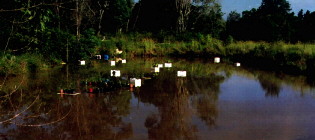
The fleet becalmed, about day 3, looking east.
I have concentrated on using materials that are freely available from the local tip, as discards from consumer society. At the tip we have a
freesHop, that supplies plant pots, mulch, wooden and steel frames, plastic sheets, string, carpeting, underfelt, coolite sheets and some coolite boxes. A lot of our fruit and vegetables in this area come in coolite or polystyrene boxes, which the supermarket discards. The local one is helpfully keeping these for us; most of the plants are floating in these boxes. I have also constructed a variety of small rafts, using dumped aluminium sheets and doors, wooden and steel frames, and heavy plastic real estate advertising sheets, buoyed beneath with empty milk and soft drink bottles.Plants currently afloat and growing successfully (so far), are;
Alongside the floating nursery is a small conventional one, where all the above are also grown. Denise, my wife and I grow rainforest trees and seedling fruit trees, and some other plants such as native shrubs and herbs, and sell them around the district, off our flat bed utility truck. This is a subtropical place, and so small pots dry out very quickly, and require incessant watering. We cannot successfully grow anything in pots less than six inches in diameter because of this. Watering takes a lot of time, and petrol for the pump. The floating nursery started as an experiment to address this problem. In growing a plant in a pot, the greatest weight involved is the water. So the idea is to see if the plant can go to the water easier than the water to the plant. Other problems that this approach may help solve are earthworms, which turn the contents of the pots into a sticky sludge, some forms of insect damage, mice digging up and eating newly planted seeds, and weed control.

Drifters becalmed
If the methods developed are successful, at least for some types of plants, it may prove possible and worthwhile to grow crops commercially on protected stretches of water. As dam building usually takes place on valuable agricultural land, which is then lost to cropping, floating crops may allow dual usage. This could be a valuable source of extra food for poor communties everywhere. This may give many landless people around the world a chance to grow some of their own food. All methods and technologies are and will remain free for anyone to use. They will not be patented, decorated with plant breeder's rights, or smothered in trademarks. Our literature may be freely copied, by anyone. Notes giving some background to the project are given in
First days.We hope to have other pilot projects, both larger and smaller, underway soon. We also need one or more volunteer Internet secretaries, for English and any other languages. The only requirements are interest, competence, a command of the grammar of your preferred language, and an honest approach to science. If you are interested, please email me.
Membership is open to anyone interested in growing floating plants on water by organic methods. Corporate membership is \$200 annually, and is welcomed. Membership entitles you to take part, in any way you choose and can do effectively, in a scientific project just starting, and which may prove to be of some use. You will also receive by email, if you want them, updates of the records and results of the test project. In ordinary English. See
Logbook of the Closeburn Sailingplant Club for a sample. Funds if any will go to keeping the project, the webpage and the worker, me, afloat. I will get a flat $15 per hour, which is half pay for tradesmen and consultants around here, if funds are sufficient. Anything over that goes to expand this project, or help launch others. So far, income has been $200 for the article published by acres, and $20 from a wealthy member. The project continues, undaunted by this irrelevance, cash.
If you like, sign our guest book
View guestbook
For membership or further details contact
Peter Ravenscroft at Closeburn. Postal address: P.O. Box 108, Samford, 4520, Queensland. Realspace address: Lot 14, Aberfeldy Road, Closeburn, near Brisbane, Queensland, Australia. Phone Australia 07-3289 4470.